
Last year, I walked into CreativePro Week as a beaten man.
No one there would have guessed it.
From the outside, I was an Adobe Community Expert, a designer with decades of experience, a college instructor, and someone who had spent a career working with recognizable brands. I smiled, shook hands, and made sure everyone else was comfortable. That has always been one of my superpowers. But underneath it all, I was drowning.
In 2022, I lost a job I had fought hard to get. Like many designers, I suddenly found myself questioning my value in an industry that seemed to be changing faster than I could adapt. I pivoted into education, despite having no formal teaching background. I’m self-taught. I earned my bachelor’s degree in UX Design only this year. Not because I suddenly needed more knowledge, but because I needed to satisfy the minimum qualifications on job applications. That realization was difficult.
After everything I had built, I still found myself trying to prove I belonged. What hurt most wasn’t losing a job. It was feeling like no one wanted me to create anymore. Graphic design has never simply been my career. It’s the thing I love most. It’s the craft I’ve devoted my life to. When the opportunities disappeared, it felt as though a part of my identity disappeared with them.
It would have been easy to blame AI, Canva, agism, or the changing design landscape. But I couldn’t. Those things weren’t responsible for my future. I was.
More than a decade ago, my girlfriend encouraged me to stop hiding behind the work and start putting myself out there. I experimented with eHow videos. I tried live streaming before it was common. Some things worked. Many didn’t. Eventually, thanks to colleagues like Ko Maruyama and Chana Messer, I became an Adobe Community Expert. By 2019, I felt like I had finally found my place.
Then COVID changed everything. My branding mentor and close friend passed away. I lost my job. Depressed and demoralized, I once again found myself rebuilding from scratch.
So I did what I’ve always done. I kept showing up as best I could.
I volunteered as a teaching assistant for David Blatner’s preconference InDesign workshops at AdobeMAX in October of 2023. If there is a go-to guy for InDesign learning, David is the man. Yet he remains one of the most generous, ego-free people I’ve met. Instead of guarding opportunities, he creates them for others. He continually introduced me to people in the CreativePro community and encouraged me to join the team.
Meanwhile, I kept my private struggles private.
At CreativePro Week 2025 in Phoenix, I volunteered as a moderator and contributed my design knowledge. Then I was invited to participate in the five-minute "Ignite" session, where I was to present 20 slides in 5 minutes. It’s an opportunity to have five minutes of "fame." Five minutes was all it took to summarize my incredible story in front of all the conference attendees, and it changed everything.
Afterward, people who had known me for nearly a decade came up and said they had learned more about me in those five minutes than they had in the previous ten years. That surprised me.
I’ve always been uncomfortable talking about myself. My upbringing taught me to stay humble, to keep moving forward, and to let the work speak for itself. I’ve lived a life that’s taken me from design studios to professional wrestling rings, classrooms, conference stages, and some incredible creative experiences. But I rarely share that story. To me, I’m just someone who survived.
The truth is, my life has always felt like a balance of extraordinary highs and painful lows. Every incredible opportunity has seemed to come with an equally difficult loss. I’ve become so accustomed to waiting for the other shoe to drop that success often feels temporary. But that Ignite talk changed the trajectory.
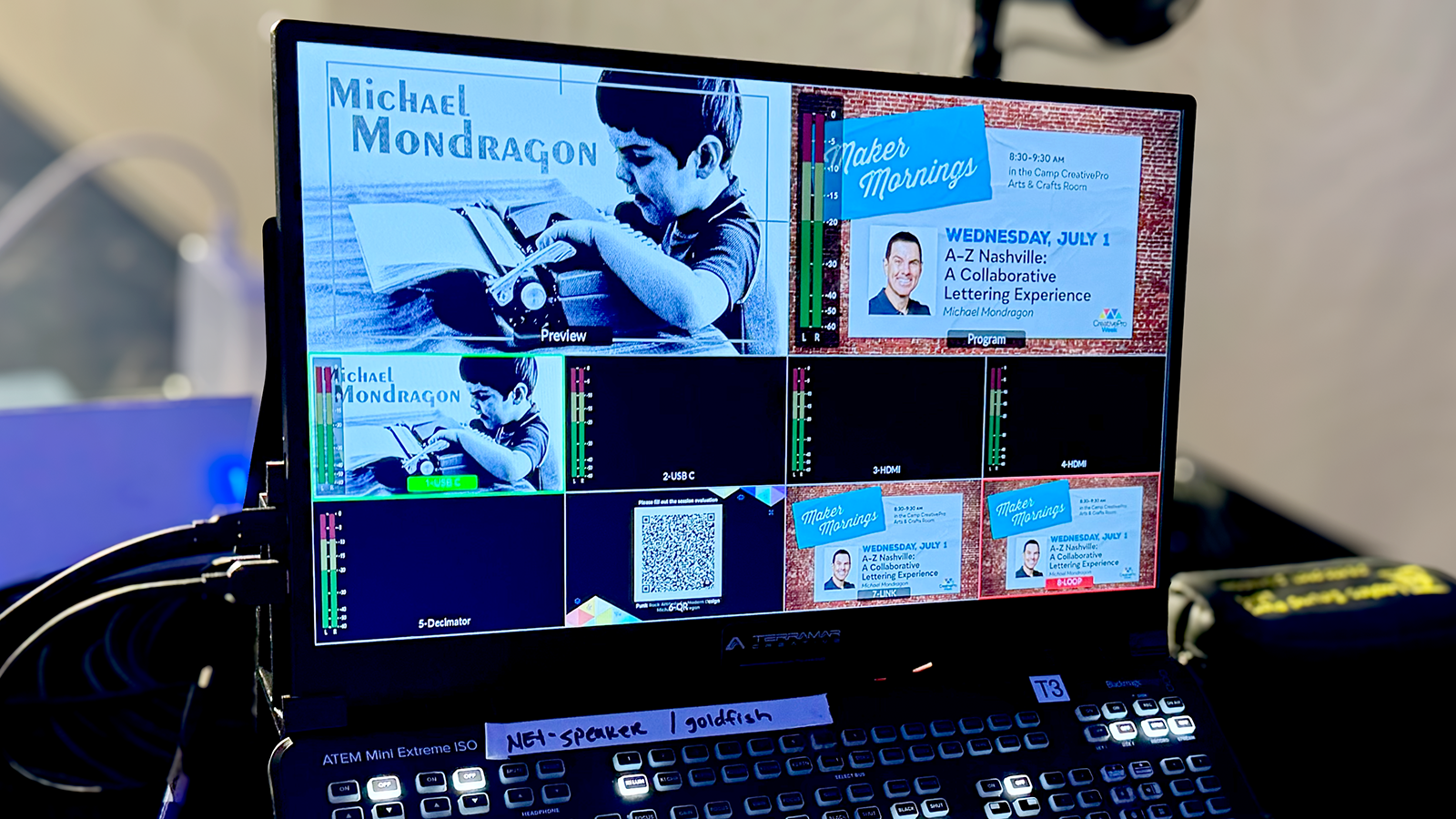
It led to an invitation to speak at CreativePro Week 2026 in Nashville, thanks to the confidence that David Blatner and Theresa Jackson placed in me. My session was titled "A Punk Rock Approach to Modern Design." A session aimed to help designers push back on defaults, trust their creative instincts, and create work that communicates more clearly, confidently, and memorably.
I didn’t spend much time worrying about attendance numbers. My only goal was to give people hope in a profession that has more questions than answers right now.
I prepared obsessively. Every sentence. Every transition. Every story. I rehearsed the presentation the way Daniel Day-Lewis prepares for a role, over and over, until it felt natural enough to disappear.
Oddly enough, professional wrestling prepared me for this moment. People assume performers get nervous because they don’t know what they’re doing. That’s never been true for me. I get nervous because I care.
The moment I walk through the curtain, whether it’s into a wrestling arena or onto a conference stage, I stop thinking and start performing. Years of experience take over. My job is to connect with the audience, not prove myself to them.
When the presentation ended, the response was overwhelming. People thanked me for being honest. Some called it their favorite session of the conference. Others told me they left inspired to stop waiting for permission and become the artist they wanted to be. Nothing could have meant more.
Then the day became even more surreal. That evening, I competed in 3 Minutes Max: Photoshop for the first time. It is a competition I’d watched for years featuring some of the best Photoshop educators in the world. Contestants have just three minutes to demonstrate a tip that surprises and delights the audience.
My secret weapon was an old production trick that I have had up my sleeve for some time. It was File > Automate > Make Droplet... A command that’s quietly existed inside Photoshop for nearly thirty years. I showed how to automate an action across 250 images in seconds, and when the audience (both in-person and online) voted, I won.
It’s difficult to explain what that moment meant. Not because I won a competition. Because a year earlier, I wasn’t sure I had a future in this profession. Now I was standing on stage among people I’d admired for years, contributing alongside them instead of wondering whether I belonged.
CreativePro Week didn’t save my career. It reminded me that my career was never about finding permission from the industry. It was about continuing to show up, sharing what I’ve learned, and helping other creatives believe that their unique experiences matter.
For the first time in a long time, I don’t feel like I’m fighting to stay relevant. I feel like I’m finally becoming the designer, educator, and storyteller I was always meant to be.
A massive thank you to the CreativePro Week crew, my fellow Adobe Community Experts, my design friends and instructors, and everyone who showed up ready to learn, connect, and inspire one another. What an unforgettable week.
Please follow me on:
Youtube: https://www.youtube.com/michaelmondragon
Linkedin: https://www.linkedin.com/in/mondragondesign/
Instagram: https://www.instagram.com/mondragondesign/
X: https://x.com/MondragonDesign
No Comments.